When The Ambulance Left, The Real Work Started.
How NurseLink Healthcare Provided Emergency On-Site Nursing Support To A Corporate Facility Following A Critical Workplace Incident
A Real-World Example Of Clinical Workforce Deployment Outside A Traditional Healthcare Setting
Introduction
Nursing agencies are most commonly associated with hospitals, aged care facilities and homecare. What is less often discussed is the growing demand for skilled nursing support in settings that have nothing to do with traditional healthcare, and the very real consequences when that support is not available at the moment it is needed most.
Corporate and industrial workplaces face health emergencies too. A serious incident on a worksite does not resolve itself once the ambulance leaves. The people who witnessed it, the colleagues who responded and the workers directly involved all carry the aftermath into the days that follow. Managing that safely requires clinical expertise that most organisations simply do not have in-house.
At NurseLink Healthcare, we deploy skilled nursing staff into environments well outside the conventional healthcare setting. This case study documents how we responded to an urgent request from a large corporate facility in Victoria following a serious workplace incident, providing on-site nursing support that addressed both the immediate clinical needs and the broader wellbeing of a workforce in shock. To protect the privacy of the organisation and individuals involved, all identifying details have been kept confidential.
To protect the privacy of the organisation, its staff and the individuals directly involved in the incident, all names, identifying details and location specifics have been kept confidential throughout this case study.
The Organisation's Background & The Incident
The organisation is a large-scale manufacturing and logistics facility in regional Victoria, employing several hundred workers across multiple shifts. The facility had existing first aid infrastructure in place, including trained first aid officers and a basic on-site medical room.
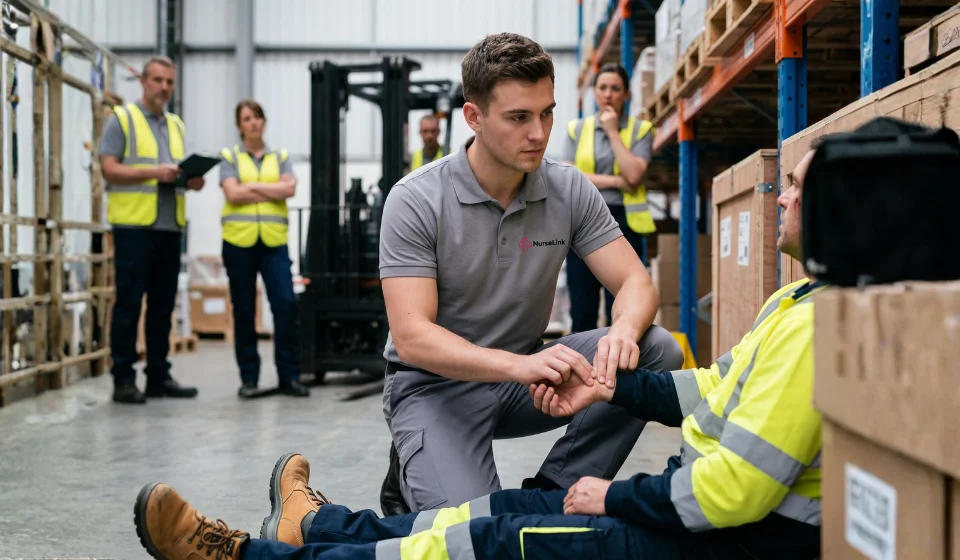
On a weekday morning during a regular production shift, a conveyor system in one of the facility’s main packaging areas malfunctioned without warning. A mechanical component failed under load, causing part of the machinery to give way suddenly. Two workers who were operating in close proximity were struck and sustained serious injuries. Emergency services were called immediately, and both workers were transported to hospital by ambulance. The affected section of the production floor was shut down and secured pending a formal WorkSafe investigation.
Within the hour, it became clear that the impact extended well beyond those physically injured. The malfunction had been loud, sudden and visible to a large portion of the surrounding workforce. Dozens of colleagues had either witnessed the moment it happened or rushed to the scene in the immediate aftermath. The combination of the noise, the speed of the event and the visible distress of the injured workers left a significant number of people in a state of acute shock.
Workers across the facility were visibly affected. Some were refusing to return to their work areas, unable to walk past the section of the floor where the incident had occurred. Others were presenting to the first aid room with symptoms the first aid officers were not equipped to manage, including trembling, shortness of breath, acute anxiety and in several cases what appeared to be early signs of psychological shock. The production environment, which had been running at full capacity just hours earlier, had come to a near standstill.
The first aid officers were doing their best but were trained for physical injuries, not the complex health needs now presenting across the workforce. The HR team had no clinical capacity to support what was unfolding. The facility’s general manager contacted their WorkSafe insurer, who recommended they seek qualified nursing support immediately. NurseLink Healthcare received the call just after midday. Clinical staff were needed on site by early afternoon.
Understanding What The Facility Actually Needed
When the call came in, it was not entirely clear even to the facility what kind of nursing support they were asking for. Our team asked the right questions quickly. How many workers were directly involved and what were their injuries? How many others had witnessed the event? What was the current state of the broader workforce? What clinical resources were already on site? Was the employee assistance programme active? What was expected over the remainder of the shift and into the following days?
From this, a clear picture emerged. The immediate need was for registered nurses who could assess and support workers presenting with stress-related symptoms, triage those needing further care, support the overwhelmed first aid officers, maintain a visible and reassuring clinical presence across the facility and document everything accurately given the WorkSafe investigation now under way.
Beyond the day of the incident, the facility also needed a plan for the days that followed. Workers returning to a site where something serious had happened would need continued support. Some would manage the transition without difficulty. Others would not.
NurseLink Healthcare committed to having two registered nurses on site within two hours and outlined a proposed support framework for the following week. The facility agreed and our team began mobilising immediately.
The NurseLink Healthcare Solution Delivered
Rapid On-Site Deployment
Two experienced registered nurses arrived at the facility that afternoon within the committed timeframe. Both had occupational health and workplace wellbeing backgrounds, directly relevant to the environment they were walking into. They were briefed during transit, arrived with a clear understanding of the situation and reported directly to the HR manager and general manager on arrival. They oriented quickly to the on-site medical room and began receiving workers within the first thirty minutes.
Clinical Assessment Across The Workforce
Throughout the remainder of that first day, the NurseLink nurses worked through a significant volume of worker presentations. Each person who came forward was assessed individually, with notes taken and clinical judgements made about the appropriate level of support or referral.
Several workers were identified as requiring same-day referral to their GP or a mental health professional, and the HR team was briefed with appropriate clinical context to support those referrals. For the majority, the support took the form of a structured clinical conversation, physical assessment where indicated and clear information about what they were experiencing and why. For many workers, having a qualified health professional take their symptoms seriously and explain them plainly was itself a meaningful part of the response.
Support For First Aid Officers
The facility’s first aid officers had been managing an overwhelming afternoon with tools not designed for what they were facing. The NurseLink nurses worked alongside them rather than displacing them, providing clinical guidance, supporting complex presentations and giving the first aid team a clearer framework for deciding when a situation needed escalation. By the end of the first day, the first aid officers reported feeling significantly more confident and less isolated.
Thorough Documentation
Given the WorkSafe investigation running concurrently, documentation was not a formality. Every presentation was recorded accurately, every assessment noted and every referral documented with the clinical reasoning behind it. This created a clear and defensible record of the health response provided, which the facility’s legal and compliance team later confirmed was precisely what they needed.
Continued Presence Over The Following Days
In the days that followed, NurseLink Healthcare maintained a daily on-site nursing presence during peak shift hours. The volume of presentations reduced as the week progressed, but the value of having clinical support available did not. Workers who had not come forward on the day began presenting later, some experiencing delayed stress responses they had initially dismissed as tiredness. Having nursing staff available meant nobody fell through the gaps simply because they had not reacted immediately. Our team provided a daily briefing to HR and management, summarising presentations, flagging workers who warranted follow-up and advising on when it would be appropriate to step back the nursing presence.
Outcomes & Impact
Clinical Support Was In Place The Same Day
Qualified nursing support was available to the workforce on the day the incident occurred, within hours of it happening. Workers experiencing genuine health responses to a traumatic event had access to a registered nurse rather than being sent home and told to call their GP. For the individuals involved, this made a practical difference to how they experienced and processed what had happened.
No Secondary Health Incidents Occurred
Throughout the period of NurseLink Healthcare’s on-site presence, there were no secondary health incidents requiring emergency response. Several workers assessed as higher risk were referred promptly and did not deteriorate. The facility’s management acknowledged that the proactive clinical presence had likely prevented situations that could have become significantly more serious if left unaddressed.
WorkSafe Documentation Was Complete And Defensible
The nursing records produced throughout the engagement provided the facility with a thorough clinical account of the health response delivered. The facility’s legal team specifically noted the quality and completeness of this documentation as an asset in managing the investigation.
Internal Staff Were Not Left To Manage Alone
The HR team, first aid officers and management had all been under significant pressure from the moment the incident occurred. Having NurseLink Healthcare take clear ownership of the clinical response meant these internal teams could focus on their own responsibilities without being pulled into clinical decisions they were not qualified to make.
Recommendations For Future Preparedness
As the engagement concluded, our team provided the facility with a written summary of observations and recommendations. This included suggestions around strengthening on-site first aid capability, establishing a clear protocol for engaging external nursing support following future incidents and reviewing the employee assistance programme activation process. The HR director indicated these recommendations would be incorporated into the facility’s updated workplace health and safety procedures.
Facility Management Reflection
The facility’s general manager shared their experience following the engagement:
“We had never been in this situation before and honestly had no idea what to do beyond the immediate emergency response. When the NurseLink nurses arrived that afternoon, the whole atmosphere on the floor changed. Workers could see that someone qualified was there and taking things seriously. The support over the following days was just as important, and the documentation they provided ended up being critical for our WorkSafe obligations. We will absolutely have a plan in place to engage them immediately if anything like this ever happens again.”
Key Takeaways From This Case Study
Workplace incidents create health needs that go well beyond physical injury. The psychological and stress-related responses that follow a traumatic event are clinically significant and require qualified nursing support to manage safely. First aid officers, however capable, are not equipped for this role.
Speed of response is a clinical factor, not just an operational one. The sooner qualified nursing support is on site, the more effective it is. Delays mean more workers presenting in a deteriorated state and a longer recovery period for the workforce overall.
Documentation in these situations serves both clinical and legal purposes. Organisations facing WorkSafe investigations need a clear, professional record of the health response provided. Nursing staff who understand this produce records that serve both purposes simultaneously.
A visible clinical presence changes the dynamic of a traumatised workplace. Workers who can see a qualified nurse actively engaging with their colleagues are more likely to come forward themselves and more likely to feel the organisation is taking responsibility seriously.
Conclusion
Serious workplace incidents are situations organisations hope never to face. But hoping they will not happen is not the same as being prepared for when they do.
At NurseLink Healthcare, our workforce solutions extend well beyond hospitals and aged care. We are experienced in deploying skilled nursing staff into environments and situations that fall outside the conventional healthcare system, and doing so quickly enough to make a genuine difference.
This case study is an example of nursing at its most unexpected. A manufacturing facility, a traumatic incident, a workforce in distress and a management team with no roadmap for what came next. NurseLink Healthcare provided the clinical expertise, the staff and the structure the situation demanded, from the same afternoon it began.
If your organisation does not currently have a plan for accessing qualified nursing support following a serious workplace incident, now is the right time to put one in place. Reach out to the Nurselink Healthcare team to discuss how we can support your workplace health obligations before you urgently need us.
Latest Post
When The Roster Falls Apart At Midnight
When The Ambulance Left, The Real Work Started.
One Sick Call, One Struggling Ward
Reliable Nursing Support At Home
Ensuring Continuity Of Care With Nursing Agency Support

Restoring Stability In Aged Care