
Keeping The Unit Open
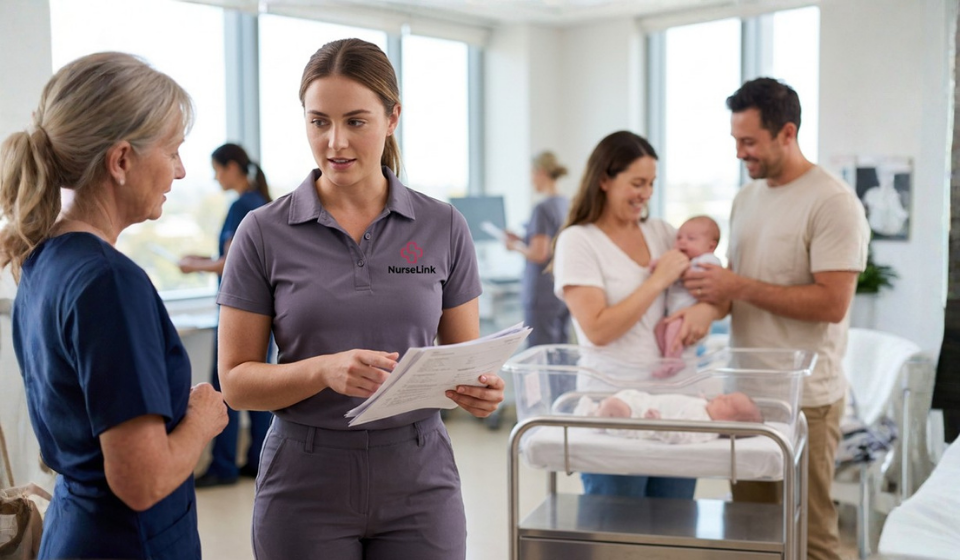
NurseLink Healthcare's Response To A Maternity Unit On The Verge Of Closure
How The Right Nurses, At The Right Time, Kept A Community Birthing Service Running
Introduction
There are some services in a community that carry a weight beyond their clinical function. A maternity unit is one of them. It is the place where families begin. Where the most ordinary and most extraordinary thing a human being can experience happens, quietly and completely, in the care of people who have chosen to be present for it. When a maternity unit closes, even temporarily, the impact is felt not just in the practical inconvenience of longer drives to the next nearest facility. It is felt in the sense that something essential has been taken from a community, something that belonged to it.
Across regional and outer metropolitan Australia, maternity units have been under sustained pressure for years. The national midwifery and obstetric nursing workforce is stretched, recruitment into regional positions is chronically difficult, and the gap between the number of qualified nurses and midwives a unit needs to operate safely and the number it can actually attract and retain has, for many facilities, been quietly widening for some time.
When that gap becomes critical, the choice a facility faces is stark. It can close the unit, redirecting expectant mothers to services further away and absorbing the community fallout that follows. Or it can find another way.
At NurseLink Healthcare, we exist to provide that other way. This case study documents how our team supported a maternity unit in the Canberra region, Australian Capital Territory, through two to three months of critical nursing and midwifery shortfall, at a point when closure had moved from a possibility to an imminent reality, and how the right nurses, deployed at the right moment, kept the unit open and kept families where they belonged.
To protect the privacy of the facility and the individuals involved, all identifying details have been kept confidential throughout this case study.
The Facility & Its Situation
The maternity unit at the centre of this case study is part of a community hospital serving a broad catchment area in and around the Canberra region. It operates as a low to moderate risk birthing facility, supporting women through labour, birth and the immediate postnatal period, with transfer pathways to a larger tertiary facility for cases requiring obstetric intervention or neonatal intensive care.
For the community it serves, the unit represents something significant. Many of the families who come through its doors have chosen it specifically because of its size, its atmosphere and the continuity of care it offers, something the larger tertiary hospitals in the region, for all their clinical capability, can find difficult to replicate. The midwives and nurses who work there tend to know their patients, to follow their pregnancies across antenatal appointments and to be genuinely present in the birth experience in a way that matters to the families who choose this path.
The unit’s staffing crisis had not arrived suddenly. It had been building over the better part of a year, driven by a combination of factors that will be familiar to anyone working in regional healthcare in Australia. Several experienced midwives had retired within a relatively short period, and the positions vacated had proven difficult to fill through standard recruitment. The pool of qualified midwives willing to take on regional roles was limited, and the time required to recruit, credential and onboard permanent staff had consistently outpaced the rate at which the unit was losing people.
In the months preceding the engagement with NurseLink Healthcare, the unit’s nurse manager had been running the service on a combination of overtime from the remaining permanent staff, casual shifts from a small number of locals already known to the service and a mounting sense of dread about what would happen when the next person handed in their notice or went on leave.
When two midwives within a fortnight of each other announced extended personal leave, the unit’s capacity to roster safely fell below the threshold required to maintain operations. The nurse manager, who had been managing the shortfall with quiet determination for months, informed the hospital’s executive team that without additional qualified nursing support in place within weeks, the unit would need to be suspended.
The executive team escalated immediately. NurseLink Healthcare was contacted the same week.
Understanding What The Unit Actually Needed
The initial conversation NurseLink Healthcare had with the unit’s nurse manager was one that she had clearly prepared for carefully. She had been thinking about what the unit needed and how to describe it for some time, and when the opportunity to describe it arrived, she was precise.
She needed registered nurses and midwives who could work in a small, community-oriented maternity unit without requiring the kind of support and orientation that a junior or inexperienced nurse would need. The remaining permanent staff were already stretched to their limit, and the capacity to mentor, supervise or carry a less experienced placement was simply not there. The nurses NurseLink Healthcare sent needed to arrive ready to practise, to understand the environment quickly and to integrate with a small, close-knit team that was tired and under pressure and would respond to competent, warm colleagues far better than to strangers who needed hand-holding.
She was also specific about the clinical scope required. The unit’s caseload included women across the low to moderate risk spectrum, and the nurses placed needed to be comfortable with the full range of care that entailed, from supporting normal labour and birth to recognising the presentations that required escalation and managing that escalation calmly and correctly. Intrapartum care, postnatal care, newborn assessment and breastfeeding support were all part of the daily reality, and nurses without genuine experience across all of these areas would not be adequate for what the unit needed.
And she asked, with a directness that the NurseLink Healthcare care coordinator found entirely reasonable, for honesty. If NurseLink Healthcare could not provide what the unit genuinely needed, she needed to know that clearly and quickly so she could pursue other options. She did not have time for promises that did not hold.
NurseLink Healthcare’s response was equally direct. The placement would be built on the right people, not the available people, and the nurse manager would know exactly who was being placed and why before anyone arrived.
The NurseLink Healthcare Solution
Midwifery Experienced Nurses Selected For The Specific Context
NurseLink Healthcare’s response to the brief began with a targeted search through its specialist nursing network for registered nurses and midwives with genuine experience in community and low intervention maternity settings. This distinction mattered. Nurses with strong backgrounds in tertiary obstetric units carry valuable clinical experience, but the culture, pace and clinical context of a small community maternity unit are meaningfully different, and a nurse whose entire background is in a high intervention tertiary environment can find the adjustment to a community setting more significant than either party anticipates.
The nurses NurseLink Healthcare identified and placed had experience in settings comparable to the unit itself. They understood the particular rhythm of low intervention midwifery care, the relational dimension of a unit where continuity of care is a genuine priority and the clinical judgement required to manage within a low to moderate risk scope while knowing precisely when and how to escalate beyond it.
Each nurse was credentialled thoroughly before placement, with AHPRA registration verified, clinical references obtained and mandatory training currency confirmed. The nurse manager received a full profile of each person being placed before they arrived, including their relevant experience and the specific reasons they had been selected for this unit. The honesty she had asked for was built into the process from the outset.
Integration With A Team That Needed Support, Not Disruption
The first week of the engagement was, in the nurse manager’s later assessment, the most important. Agency nurses arriving into a small, close-knit team that is under pressure and emotionally stretched can either ease the burden or add to it, and the difference often comes down to the person rather than the qualification.
The nurses NurseLink Healthcare placed understood this dynamic instinctively. They arrived with the clinical confidence to practise independently, which meant the permanent staff were not drawn into supervision, and with the professional humility to learn how this particular unit worked before assuming that their way was the right way. They asked the right questions, listened to the answers and quickly found their place within the team’s existing rhythms rather than disrupting them.
Within the first fortnight, the nurse manager noted that the dynamic in the unit had shifted perceptibly. The permanent staff, who had been carrying a level of strain that was beginning to show in the texture of their daily interactions, had begun to decompress slightly. The simple fact of enough people on the roster to cover shifts without everyone working beyond their sustainable limit was having an effect that went beyond the operational.
Maintaining The Unit's Standard Of Care
Throughout the engagement, the standard of care provided to women and families using the unit was maintained without compromise. The postnatal ward continued to run as the families using it expected it to. Antenatal and intrapartum care was delivered by nurses who understood the importance of the relational dimension of maternity care and who brought genuine warmth and clinical competence to every interaction.
There were no adverse clinical events attributable to the staffing transition. Escalations that needed to happen were managed correctly and promptly. And the feedback from families who gave birth at the unit during the engagement period reflected an experience of care that was consistent with the unit’s reputation, which, given that the unit had been operating at the edge of its capacity when the engagement began, was itself a meaningful outcome.
Supporting The Permanent Recruitment Process
While NurseLink Healthcare’s nurses held the unit together operationally, the hospital’s human resources and nursing leadership teams were able to pursue the permanent recruitment process with the focus it required. With the immediate crisis of insufficient staffing coverage addressed, the pressure that had been making considered recruitment difficult was relieved enough to allow proper interviews, appropriate reference checking and the measured onboarding of incoming permanent staff.
NurseLink Healthcare’s nurses actively supported the integration of new permanent staff as they arrived progressively across the later weeks of the engagement, sharing the operational knowledge they had built and helping new starters settle into a unit that was, by that point, functioning steadily rather than surviving precariously.
Outcomes & Impact
The Unit Did Not Close
The most fundamental outcome of this engagement was the one that had been in genuine doubt when the brief first arrived. The maternity unit remained open throughout the engagement period. Families in the community who had booked to give birth there were able to do so. The unit’s reputation, built over years of providing genuinely good care to the families it served, was protected. And the community did not have to absorb the loss of a service that mattered to it in ways that go beyond the clinical.
The Permanent Nursing Team Recovered
The relief provided by the NurseLink Healthcare placement had a measurable effect on the wellbeing of the permanent nursing staff who had been holding the unit together under pressure for months. The nurse manager described the change in her team over the course of the engagement as one of the more significant outcomes she observed. People who had been visibly depleted began to have enough left at the end of a shift to be themselves again. The culture of the unit, which had been under strain, began to recover.
Families Received The Care They Had Chosen
For the families who gave birth at the unit during the engagement period, the staffing crisis that had nearly closed the service was, rightly, invisible to them. They arrived, were cared for, brought their children into the world and went home with the experience of having been looked after well. That invisibility was, in its own way, the clearest possible measure of how well the engagement had worked.
A Reflection From The Nurse Manager
In her feedback to NurseLink Healthcare following the conclusion of the engagement, the unit’s nurse manager shared the following:
“I have worked in maternity for a long time and I have seen what happens to units when the staffing gets to where ours was. I was genuinely frightened we were going to have to close, and I knew what that would mean for this community. What NurseLink sent us were not just nurses who could fill shifts. They were midwives who understood what this kind of unit is for, who cared about the families they were looking after and who gave my permanent team the breathing room they desperately needed. We are still open. The families who came to us during that period had good births. That is what this is all about.”
Key Takeaways From This Case Study
Maternity unit closures have consequences that extend far beyond the clinical. When a community loses its birthing service, it loses something that belongs to the fabric of how that community understands itself. The stakes of maintaining a maternity unit through a staffing crisis are not only operational. They are human, and they deserve to be treated as such.
Experience in the right setting matters as much as qualifications on paper. A nurse who is highly skilled in a tertiary obstetric environment brings genuine value, but not necessarily to a small community maternity unit that operates on different rhythms and relationships. Matching clinical background to clinical context is a non-negotiable element of effective placement in specialised settings.
Agency support that integrates well is a different thing from agency support that merely arrives. The impact of a nursing agency placement on a small, pressured team depends as much on the interpersonal qualities of the nurses placed as on their clinical credentials. NurseLink Healthcare’s selection process attends to both, because both matter.
Breathing room for permanent staff is itself a clinical outcome. Nurses and midwives who are running beyond their sustainable capacity cannot deliver the standard of care they are trained to deliver and want to provide. Agency support that relieves that pressure does not just solve a rostering problem. It protects the quality of care that patients receive.
Conclusion
Maternity units are not interchangeable with other clinical services. They carry a particular meaning in the communities they serve and a particular responsibility in the lives of the families who come through their doors at one of the most significant moments of their lives.
When the unit at the centre of this case study came close to closing, what was at stake was not simply an operational continuity question. It was the births that would have happened somewhere else, the families who would have had a different experience and the permanent nursing team that had given years to building something worth preserving and was watching it come under threat through no fault of their own.
NurseLink Healthcare provided the nursing support that kept the unit open, the families together with the care they had chosen and the permanent team with the room to recover. That is what nursing agency support, done properly, can make possible.
If your maternity unit, or any healthcare service you lead, is facing a staffing shortfall that threatens what you have built, we welcome the conversation. NurseLink Healthcare is here to help you keep the doors open and the standard of care where it belongs.
Latest Post

Open On Day One

When The Wards Couldn’t Wait
Burnout Across An Entire Healthcare Team

When The Roster Falls Apart At Midnight

When The Ambulance Left, The Real Work Started.

One Sick Call, One Struggling Ward