
The Father Who Kept Showing Up
How NurseLink Healthcare Restored A Family's Trust In The NDIS
A Case Study In NDIS Support For A Child With Acquired Brain Injury, Built Around A Father
Introduction
There is a specific kind of exhaustion that belongs to the parent of a child with complex disabilities who has been through the NDIS system long enough to have learned, through repeated experience, not to expect too much. Not because they have given up on their child. They never give up on their child. But because the gap between what the system promises and what it consistently delivers has, over time, produced a guardedness that is both entirely reasonable and genuinely heartbreaking to witness.
These are parents who attend intake meetings and answer the same questions they have answered many times before. Who watch new support workers arrive with good intentions and leave when the complexity becomes more than they signed up for. Who have learned to manage their own hope carefully, because hope that is disappointed enough times becomes something more complicated than hope, something closer to a reflex held at arm’s length.
What these families need, and what they have usually stopped believing they will find, is a provider that does not just read the care plan but reads the child. That does not treat the complexity of his needs as a problem to be managed but as the specific reality of a specific person to be understood. That arrives and stays and builds the kind of relationship with the child and his family that the word support is actually supposed to mean.
At NurseLink Healthcare, we hold this responsibility without reservation. This case study documents how our team supported a boy with acquired brain injury in Adelaide, South Australia, and the father who had been his primary carer through years of a system that had not yet found a way to adequately support either of them, and how the right provider, arriving at the right moment, changed what the family believed was possible.
To protect the privacy of the child and his family, all names and identifying details have been kept confidential throughout this case study.
The Child & His Family's Situation
The child at the centre of this case study is a boy aged between eight and ten living in Adelaide with his parents and his younger sister. He sustained an acquired brain injury at the age of four as the result of a medical event that was sudden, frightening and, in the way of these things, entirely without warning. The injury affected multiple areas of his development, producing physical impairments that required wheelchair use and significant personal care support, cognitive impairments that affected his learning, memory and processing, communication difficulties that meant his expressive language was limited and inconsistent, and a pattern of emotional and behavioural responses to frustration and sensory overload that required careful, experienced management from the people around him.
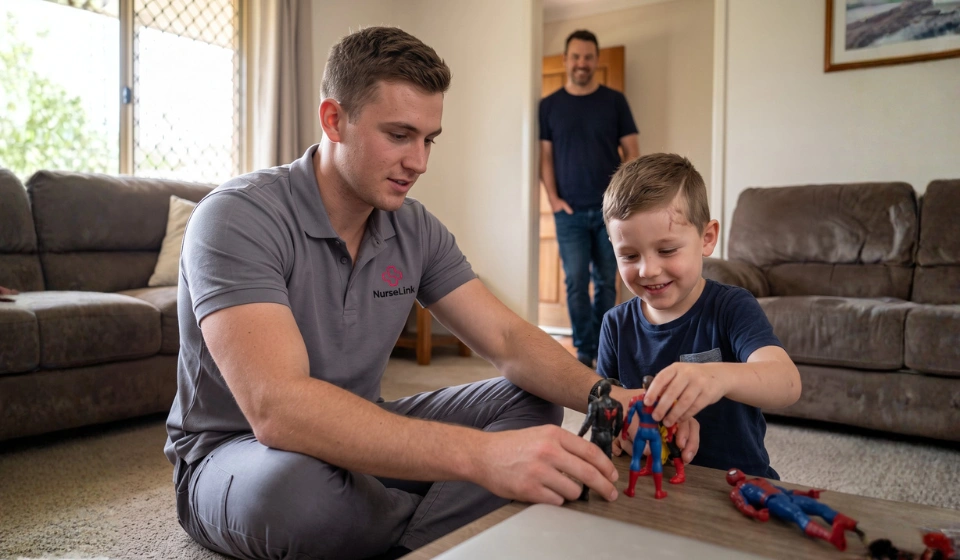
He was also, as his father said at the first assessment meeting with a directness that suggested he had said it many times and intended to keep saying it until someone heard it properly, a child. He liked superheroes. He had a favourite colour. He had opinions about what he watched on television and about which of his stuffed animals was allowed to sit where and about whether his food was touching other food on his plate, which it was not allowed to be. He communicated these opinions through a combination of vocalisations, facial expressions and the particular physical tension that the people who knew him well had learned to read with considerable accuracy. He was not his diagnosis. He was a boy who had a diagnosis, and the distinction mattered to his father in a way that went well beyond semantics.
His mother worked full time as a nurse, a career she had maintained partly from financial necessity and partly because her own sense of self required a space outside the weight of their family’s situation. His father had become the primary carer, reducing his own work to part time in the years following the injury to manage the school drop-offs and pick-ups and therapy appointments and the daily complexity of caring for a child whose needs were significant and specific and did not pause for weekends.
He was, by the time NurseLink Healthcare first spoke with him, a man who had been doing this for several years and who had absorbed the particular toll that several years of this does to a person. He was not broken. He was competent and committed and deeply loving and thoroughly, quietly exhausted. And he had been through enough providers to have stopped, as he said himself, getting his hopes up.
What The Family Had Been Through Before NurseLink Healthcare
The history of NDIS provider engagements that preceded NurseLink Healthcare’s involvement was a history that his father recounted without bitterness, because bitterness was a luxury that the daily demands of his situation had not left him much room for, but with the precision of a man who had learned, through experience, what to watch for and what questions to ask.
The first provider had been adequate for the first several weeks and had then begun sending different support workers to each visit, a rotation that produced in his son the behavioural responses to unfamiliarity that anyone who understood his condition would have anticipated and that had resulted, within two months, in the provider suggesting that his son’s needs were beyond what they could consistently meet.
The second provider had lasted longer and had produced one support worker who had genuinely understood his son and with whom a real relationship had developed, followed by the departure of that support worker to another role and a replacement process that had not found anyone comparable and had eventually dwindled into an arrangement that was technically in place and practically inadequate.
The third provider had been enthusiastic at the intake meeting and had never quite translated that enthusiasm into the day to day consistency that his son required.
Each ending had required his father to begin the process again. The referrals, the assessments, the intake meetings, the careful description of his son’s needs and history and the things that worked and the things that did not, delivered to a new set of people who were going to try and might or might not succeed. Each time, he had tried to be open to the possibility that this one would be different. Each time, the openness had cost him something he could not fully afford to keep spending.
When his NDIS plan coordinator suggested NurseLink Healthcare, he had said he was willing to have the conversation. He had not said anything more optimistic than that.
Understanding What The Child & His Father Actually Needed
The initial assessment NurseLink Healthcare conducted was one that the care coordinator approached with specific awareness of the history that preceded it. She had been told, by the plan coordinator, that this was a family that had been disappointed before and that the first meeting was as much about whether NurseLink Healthcare would listen as it was about what it would hear.
His father spoke for a long time and was not interrupted. He described his son with the completeness of a person who has been the person who knows his child best for years and has learned that the more specifically he describes him, the better the chance that the person across the table will understand something real rather than something general. He described the communication system and the specific gestures and expressions that indicated different states. He described the sensory sensitivities and the transition needs and the particular way the school handover had to happen for the rest of the day to go well. He described the superheroes and the food arrangement and the stuffed animals and the television opinions, because these were his son as much as the clinical profile was, and any support arrangement that understood only the clinical profile was going to fail for the same reasons the previous ones had.
He also said something that the care coordinator wrote down and carried through the rest of the engagement planning. He said he needed the support workers who came to his house to treat his son like a person worth knowing. Not a complex case. Not a challenging client. A person. A boy with a favourite colour and opinions about his food. He had stopped expecting this, he said, but it was still what he needed, and if NurseLink Healthcare was not able to provide it, he would rather know now.
The care coordinator told him that this was the standard NurseLink Healthcare held its support workers to, and that if it was not being met, she wanted him to tell her, because she needed to know. He looked at her for a moment and said he had heard something like that before. She said she understood why that would make it harder to believe, and that she was asking him to give the arrangement time to show him rather than asking him to simply take her word for it.
He said that was fair.
The NurseLink Healthcare Solution
Support Workers Selected For This Specific Child
The selection process NurseLink Healthcare applied to this engagement was as thorough and as specific as any it conducted, because the history of previous arrangements made it clear that the quality of the match was the determining factor in whether the engagement would succeed or become another entry in a list of disappointments.
NurseLink Healthcare identified support workers with specific experience in acquired brain injury support for children, including familiarity with the physical care requirements of a wheelchair user, experience with augmentative and alternative communication approaches and the specific training in positive behaviour support that his emotional and behavioural profile required. These were the clinical minimum. They were not the whole of what the selection was looking for.
Beyond the clinical credentials, NurseLink Healthcare was looking for people who had the quality his father had described as a person worth knowing, the genuine interest in a child as a person rather than as a care task, the patience and the warmth and the particular kind of professional commitment that is not the same as enthusiasm at an intake meeting but shows up consistently on an ordinary Tuesday afternoon when the visit is routine and the child is tired and nothing about the day is remarkable.
Two support workers were identified, briefed comprehensively and introduced to the child and his father in a pre-commencement visit at the family home. The visit was informal. No clipboards. His father made coffee. His son was in the lounge room watching television, and the support workers were introduced to him there, in his space, on his terms, without the clinical formality that transitions him toward the behavioural responses that unfamiliarity produces when it is managed without care.
One of the support workers noticed the superhero figures arranged on the shelf beside the television. He asked, directly and simply, which one was his favourite. The boy looked at him for a long moment and then looked at the shelf and then looked back at the support worker, and his father, watching from the doorway, said nothing but noted it.
Consistency Built Into The Structure Of The Engagement
NurseLink Healthcare structured the placement with consistency as its organising principle, because the clinical and relational case for consistency in supporting a child with acquired brain injury was clear and because the history of the previous arrangements had demonstrated, in the most practical terms, what inconsistency cost this particular family.
The same two support workers were rostered for all of his visits, with any change to the roster communicated to his father in advance and managed with the transition preparation that his son required. The schedule was structured around the rhythms of his day and the specific times that his support needs were greatest, and the structure was maintained with the reliability that a child whose sense of safety was closely linked to predictability required.
His father noticed the consistency before he commented on it, which was, given his history with previous providers, exactly the right order for it to happen. He noticed it across several weeks of visits that went as planned, with the people he had been told would come coming at the time he had been told they would come and managing his son in the way that had been agreed. He did not immediately trust it, because trust that has been worn down requires more than a few weeks of evidence to rebuild. But he noticed it, and noticing was the beginning.
Clinical Support That Met His Physical & Cognitive Needs
Every visit incorporated the structured clinical support that his physical and cognitive impairments required. Personal care was managed with the specific handling approach his physical profile required, attended to with the dignity and the matter-of-fact competence that made it a routine rather than an ordeal. His communication was engaged with through the specific system his speech therapist had developed, with support workers who had taken the time to understand it and who used it consistently rather than defaulting to simpler interactions that his system was designed to move beyond.
His behavioural and emotional support was managed through the positive behaviour support framework that his support plan described, applied not as a set of techniques deployed in response to difficult moments but as the consistent, preventative approach to his daily environment and interactions that the framework was designed to be. His support workers were attentive to the early indicators that preceded his most challenging responses and managed the environment and the interaction accordingly, which reduced the frequency of those responses in a way that the previous providers, who had tended to manage reactively rather than preventatively, had not achieved.
His father noticed this too. He had been so accustomed to debriefing difficult incidents after visits that the reduction in their frequency was disorienting at first, in the way that the absence of something you have been managing for a long time can be disorienting. He raised it with the care coordinator, not as a complaint but as a genuine question about what was different. The care coordinator explained the preventative approach and what it was producing. His father was quiet for a moment and then said that made sense and that he wished someone had explained it to him earlier.
Working With The School & Therapy Teams
NurseLink Healthcare maintained active communication with his school support team and his therapy providers throughout the engagement, ensuring that the support being delivered in the home environment was aligned with the goals and the approaches being used in his other settings. His physiotherapist’s movement programme was incorporated into daily visits. His speech therapist’s communication goals were reflected in the interaction approach his support workers used. The school’s behavioural support strategies were consistent with the approach used at home.
This coordination was not complicated, but it required the commitment to make the calls and attend the meetings and maintain the communication that made it real rather than nominal. His father had been coordinating across these teams himself for years, largely without support, and the experience of having someone else hold some of that coordination was something he mentioned at a review meeting several months into the engagement as one of the things that had made the most practical difference to his daily life.
Support For His Father As Well As His Son
NurseLink Healthcare’s care coordinator had understood from the initial assessment that the support this engagement needed to provide extended beyond the clinical management of the child to the father who had been carrying this largely alone for years. This was not a formal component of the support plan, which was structured around his son’s NDIS goals. It was a human understanding of the reality of the family’s situation, applied through the consistent attentiveness of a care coordinator who checked in with him genuinely and regularly, who asked how he was doing and waited for a real answer and who treated the information he provided as the important clinical and human input that it was.
He did not talk easily about how he was doing. He had learned, through years of being the person who managed things, to keep his own state largely to himself. But across the months of the engagement, as the consistency of the arrangement built and the trust that had been worn down began, slowly, to repair, he became somewhat more able to say when he was struggling and somewhat more willing to let the care coordinator help him find the practical adjustments that would help.
His partner, coming home from work to a household that was managing better than it had in years, noticed the change in him in the way that partners notice things without immediately naming them. She raised it with him one evening and he said, simply and without elaboration, that this time felt different. She asked why. He said he thought they had finally found people who actually got it.
Outcomes & Impact
His Son Engaged With Support In A Way He Had Not Previously
The change in how the child engaged with his support workers across the months of the engagement was, by his father’s account and the observations of his school team, significant and genuine. The wariness that had characterised his initial response to new support workers, the product of years of unfamiliar faces arriving and departing, gave way, over the consistent weeks of the same support workers arriving and staying and knowing him, to something that looked increasingly like comfort.
By the third month, he was initiating interaction with his primary support worker in ways that his father had not seen him do with any support worker before. He was bringing his superhero figures to show him. He was guiding him, through the combination of gesture and vocalisation and expression that was his communication, to the television programme he wanted to watch. He was, in the wordless and entirely clear way of a child who has decided someone is safe, letting him in.
His father watched this happen across the weeks and did not say much about it, because it was not the kind of thing he found easy to say much about. But the care coordinator, checking in with him at a review meeting at the four month mark, asked how his son seemed with the support workers, and he was quiet for a moment and then said he seemed happy to see them. It was three words. It was everything.
The Behavioural Incidents Reduced Measurably
The reduction in the frequency and intensity of his most challenging behavioural responses across the engagement period was noted by his father, his school team and his behaviour support practitioner. The preventative approach that NurseLink Healthcare’s support workers applied, combined with the regulatory effect of consistent, familiar support workers who had taken the time to understand his specific triggers and his specific communication, produced outcomes that the reactive management approach of previous providers had not achieved.
His behaviour support practitioner, reviewing the incident data at a six month checkpoint, noted a reduction that she described as clinically meaningful and attributed directly to the quality and consistency of the support environment NurseLink Healthcare had created around him.
His Father Found A Different Relationship With The System
The change in his father across the months of the engagement was not the dramatic transformation of a person who has had a revelation. It was quieter and more durable than that. It was the gradual rebuilding of a trust that had been worn down through years of disappointment, replaced one kept promise at a time by a provider that showed up consistently and did what it said it would do and treated his son like a person worth knowing.
He did not stop being watchful, because a parent who has been through what he had been through does not simply stop being watchful. But the watchfulness changed its quality. It became less the braced vigilance of someone waiting for the next disappointment and more the ordinary attentiveness of a parent who is paying attention because his child matters to him, not because he expects something to go wrong.
He described the change at a review meeting toward the end of the first year of the engagement as follows. He said that for a long time, his relationship with the NDIS had felt like a fight. He had been fighting for his son’s funding, fighting for adequate providers, fighting for people to understand what his son needed. He said he was still fighting in some of the ways that mattered, because the system still required it. But this particular part of it, the support in his home, the people who came to look after his son, had stopped feeling like a fight. It felt, he said, like support. Which was what it was supposed to feel like and which, for a long time, it had not.
His Partner Had Someone To Come Home To
The practical and emotional relief of an NDIS support arrangement that was genuinely working had an effect on the household that extended to his partner, who had been managing her own guilt about working full time alongside the daily reality of a home that was under significant pressure. She came home to a house that was calmer on support days. She came home to a partner who was less depleted than he had been. She came home to her son, who was spending time with people he had chosen to let in, and she saw in that the thing she had been hoping for since the injury and had not been sure she was going to see.
She told the care coordinator, in a conversation several months into the engagement, that she had started feeling like her family again rather than like a unit in crisis. It was, she said, the first time in years she had felt that way.
A Reflection From His Father
At a review meeting toward the end of the first year of the engagement, he shared the following with the NurseLink Healthcare care coordinator:
“I stopped expecting much a long time ago. Not because I stopped caring about what my son deserved but because I had learned, through experience, that expecting much just made the disappointments harder. NurseLink changed that. Not overnight and not because of anything dramatic. Because week after week, the same people showed up, they knew my son, they treated him like a person and they did what they said they would do. My son is happy to see them. I did not know how much I needed to see that until I saw it. You got it right. That is all I ever asked anyone to do.”
Key Takeaways From This Case Study
Consistency in support workers is a clinical requirement for children with ABI, not a preference. A child with acquired brain injury who has learned through experience that unfamiliar people arrive and depart will respond to a consistent, familiar support worker differently than to a rotating roster. The trust that consistency builds is not a soft outcome. It is the foundation on which every clinical goal in the support plan is achieved.
A parent who has been disappointed repeatedly requires evidence, not reassurance. A father who has been through multiple inadequate support arrangements is not going to be restored to trust by a good intake meeting. He is going to be restored to trust by weeks and months of kept promises, consistent practice and a provider that shows up when it says it will and does what it says it will do. NurseLink Healthcare understood this and let the evidence do the work.
Treating a child with a disability as a person worth knowing is not a value add. It is the clinical baseline. A support arrangement that sees a child’s diagnosis before it sees the child will not build the relationship that effective support requires. NurseLink Healthcare’s insistence that its support workers know the child, including the superheroes and the food arrangement and the television opinions, was not incidental to the clinical outcomes. It was what made them possible.
Supporting the primary carer is part of supporting the child. A father who is depleted, isolated and managing the coordination of his child’s entire support system without adequate help is not in the condition to be the parent his child needs him to be. NurseLink Healthcare’s attention to his wellbeing alongside his son’s was not peripheral to the engagement. It was part of what the engagement was for.
Conclusion
The NDIS exists to provide support that makes a genuine difference to the lives of people with disabilities and the families around them. For the family at the centre of this case study, that purpose had been obscured, for years, by a series of providers that had been unable to deliver it adequately.
NurseLink Healthcare provided the support that the system had always promised and not yet delivered. Consistent, skilled, genuinely attentive support for a boy who deserved to be known as a person. And for a father who had stopped expecting to find it, the evidence, accumulated one kept promise at a time, that it was possible after all.
His son is happy to see his support workers. That is the measure of it.
If your family is navigating the NDIS with a child with complex needs and you have been through enough providers to have stopped expecting much, we encourage you to reach out to the NurseLink Healthcare team. We understand what it costs to try again. We will not waste it.
Latest Post

When The Cycle Cannot Wait
Keeping The Clinic Running
When The Highway Brought Them In
Holding The Line

Open On Day One

When The Wards Couldn’t Wait
Burnout Across An Entire Healthcare Team

When The Roster Falls Apart At Midnight

When The Ambulance Left, The Real Work Started.

One Sick Call, One Struggling Ward
Reliable Nursing Support At Home

Ensuring Continuity Of Care With Nursing Agency Support

Restoring Stability In Aged Care