
Keeping The Clinic Running
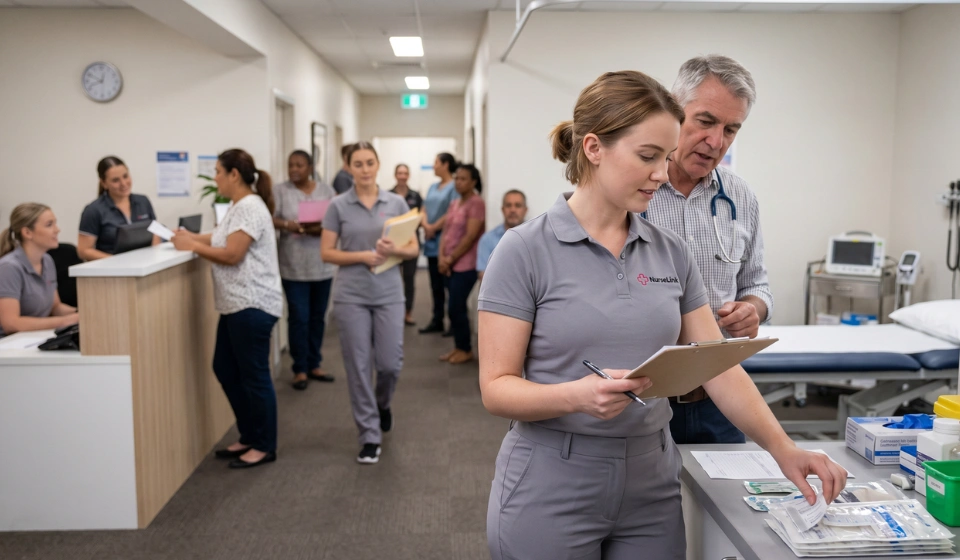
How NurseLink Healthcare Supported A Tamworth GP Clinic
A Case Study In Practice Nursing Agency Support For A Busy Regional Clinic
Introduction
A GP clinic runs on its doctors. But anyone who has worked in one knows that it equally runs on its nurses. The practice nurse is the person who takes the blood pressure before the GP walks in, processes the pathology requests, manages the immunisation schedule, follows up on chronic disease management plans, assists with in-clinic procedures and holds together the administrative and clinical workflow that determines whether a busy appointment book translates into patients who are genuinely well looked after.
When a practice has two nurses and both of them go on maternity leave within weeks of each other, the clinic does not simply become less efficient. It faces the prospect of being unable to function at the standard its patients expect and its accreditation requires.
This is not an unusual scenario. It is, in fact, one of the more common staffing challenges that GP practices across regional Australia face, particularly in clinics with smaller nursing teams where the simultaneous absence of two staff members represents a complete loss of clinical nursing capacity. The patients do not stop coming. The chronic disease management reviews do not reschedule themselves. The immunisation clinics that the community depends on do not pause while the clinic works out how to cover the gap.
What a clinic in this situation needs is a practice nurse with enough experience to step in without a lengthy orientation, enough flexibility to work across the full scope of general practice nursing and enough professionalism to represent the clinic’s standard of care to the patients who walk through the door.
At NurseLink Healthcare, we provide exactly this kind of support. This case study documents how our team helped a busy GP clinic in Tamworth, New South Wales, maintain full clinical nursing operations across a two to three month period following the simultaneous commencement of maternity leave by both of its practice nurses.
To protect the privacy of the clinic and the individuals involved, all identifying details have been kept confidential throughout this case study.
The Clinic & Its Situation
The clinic at the centre of this case study is a well-established general practice in Tamworth serving a patient population that includes families, older adults with chronic conditions, rural and agricultural workers and a significant number of patients with complex health needs who rely on the clinic for ongoing management and coordination with specialist services.
The practice runs a busy appointment schedule across several GPs, supported by a nursing team that had, until the events of this case study, consisted of two experienced practice nurses who between them covered the full clinical and administrative nursing scope that a practice of this size and complexity requires. Both nurses had been with the clinic for several years and had built the kind of deep familiarity with the patient base and the GPs’ clinical preferences that takes time to develop and is difficult to replicate quickly.
The timing of the two maternity leaves, while not deliberately coordinated, aligned in a way that left the clinic with no nursing coverage from the same week in the new year. The practice manager, who had managed staffing challenges before but had not faced a complete loss of nursing capacity, began planning for the gap several months in advance. She advertised for a temporary practice nurse, received limited response in a regional market where experienced practice nurses were not in ready supply and ultimately found herself two weeks from the start of both leaves with no solution in place.
The clinic’s lead GP, who had been watching the situation develop with increasing concern, made the call to NurseLink Healthcare.
Understanding What The Clinic Actually Needed
The conversation NurseLink Healthcare had with the practice manager and the lead GP was practical, specific and efficiently conducted by people who understood exactly what they needed and did not have time for a protracted assessment process.
The clinic needed a registered nurse with genuine general practice experience. Not a nurse who had worked primarily in a hospital setting and would need to learn the rhythms and the scope of primary care from the ground up, but a nurse who was already fluent in chronic disease management, immunisation delivery, wound care, health assessments, in-clinic procedure assistance and the particular kind of patient communication that a GP clinic requires, where the relationship with the patient is ongoing and the nurse is often the familiar face that patients feel most comfortable talking to.
The lead GP was specific about scope. The clinic ran regular immunisation clinics for children and adults, managed a significant chronic disease patient load including diabetes management, hypertension monitoring and asthma reviews, provided wound care and suture removal, assisted with minor procedures in the treatment room and coordinated care plans and referrals across a complex patient base. A nurse who could cover some of this but not all of it would not solve the problem. The clinic needed someone who could manage the full scope from the first week.
The practice manager raised something practical that mattered as much as the clinical scope. The clinic’s patient base was regional and largely long-standing. Many patients had been coming to the same clinic for years and had relationships with the nursing staff that were personal as well as clinical. The nurse who came in needed to understand that she was stepping into an existing patient relationship dynamic, not building a new one, and that the manner in which she engaged with patients mattered as much as her clinical accuracy.
The NurseLink Healthcare Solution
A Practice Nurse With The Right Background
NurseLink Healthcare identified a registered nurse with several years of general practice nursing experience in a regional setting, covering the full scope of clinical tasks the clinic required. She had run immunisation clinics independently, managed chronic disease monitoring programmes, assisted across the range of in-clinic procedures the clinic performed and was familiar with the documentation and care plan frameworks that general practice nursing involves.
She was confirmed for the placement with enough time remaining before the maternity leaves commenced to allow a structured handover with the departing nurses, an opportunity she used well. The two days she spent with the existing nursing team before they left were used to walk through the patient management systems, understand the clinical preferences of each GP, review the scheduled immunisation clinics and chronic disease reviews that were coming up in the first weeks and absorb as much of the patient-specific knowledge that the departing nurses carried as could reasonably be transferred in the time available.
The practice manager noted that the incoming nurse had asked the right questions during the handover, the ones that reflected genuine general practice experience rather than the questions of someone orienting to an unfamiliar clinical context. She arrived understanding what she needed to know and knowing how to find out what she did not yet know.
Full Clinical Coverage From The First Week
From the first week of the placement, the clinic operated at its standard clinical capacity. The appointment schedule ran as normal. Immunisation clinics proceeded on their scheduled dates. Chronic disease management reviews were conducted and documented correctly. In-clinic procedures were assisted competently. The workflow that the two permanent nurses had managed between them was managed by one experienced agency nurse without the clinical gaps or the quality compromises that an inadequate placement would have produced.
The GPs, who had been bracing for a period of reduced nursing support and the additional workload that entailed, found instead that the clinical nursing functions they depended on were being performed with the efficiency and the accuracy that allowed their own consulting time to remain focused on the clinical work rather than absorbed by tasks that should have been managed before they walked into the room.
Patient-Facing Care That Reflected The Clinic's Standard
The manner in which the placed nurse engaged with patients was, in the assessment of the practice manager and the GPs, one of the most pleasing aspects of the placement. Regional patients at a long-standing GP clinic have expectations about the quality of their interaction with the nursing staff that go beyond clinical accuracy. They expect to be treated as known individuals rather than appointments, to have their concerns heard rather than processed and to leave the clinic feeling looked after rather than simply managed.
The placed nurse understood this instinctively and delivered it consistently. She took the time with patients that the clinical interaction required. She communicated results, instructions and follow-up requirements clearly and in terms that patients could understand. She fielded the questions that patients brought to the nursing station rather than redirecting them unnecessarily to the GP. And she did all of this in a way that, by the second week of the placement, had produced several unsolicited positive comments from patients to the reception staff about the nurse who was filling in.
One elderly patient, a man in his eighties who had been coming to the clinic for over twenty years and whose chronic disease management required regular nursing contact, mentioned to his GP during a consultation that the new nurse was very thorough and very kind. His GP relayed this to the practice manager. It was noted.
Covering The Immunisation & Chronic Disease Programme
The clinic’s immunisation and chronic disease management programmes were the two areas of clinical nursing that the practice manager had been most concerned about maintaining across the maternity leave period. Both required not just clinical skill but organisational capacity, the ability to manage scheduled appointments, coordinate recalls, document correctly and ensure that the programme continued running without the gaps that would affect patient health outcomes and the clinic’s accreditation standing.
The placed nurse managed both programmes without interruption. Immunisation clinics ran on schedule and were documented correctly. Chronic disease management reviews were conducted to the standard the clinic’s care plan frameworks required. The recall system for overdue reviews was maintained, and patients who were due for monitoring but had not attended were followed up through the standard processes.
The practice manager reviewed the programme documentation at the midpoint of the engagement and found it accurate, complete and consistent with the standard that the permanent nursing team had maintained. There were no gaps, no missed recalls and no documentation that would create compliance concerns.
Reliable Communication With The Practice Team
Throughout the engagement, the placed nurse maintained clear and timely communication with the GPs and the practice manager about anything clinical or operational that required their attention. She flagged patient concerns that needed GP follow-up promptly and accurately. She raised questions about clinical preferences or practice-specific protocols through the right channels rather than making assumptions that could affect patient care. And she participated in the practice’s internal communication as a member of the team rather than as an external contractor operating at a remove from the clinical community around her.
The GPs described her communication style as exactly what they needed from a nurse who was new to the practice but experienced in the role. She knew what she could manage independently and what needed to be escalated, which is the clinical judgment that a practice environment requires and that not every nurse, regardless of their credentials, reliably demonstrates.
Outcomes & Impact
The Clinic Did Not Miss A Beat
The most straightforward measure of the engagement’s success was that the clinic continued to operate at its normal capacity throughout the two to three month period. Appointments ran. Clinics were held. Patients received the nursing support their clinical needs required. The patients who came to the clinic during this period did not experience a reduced standard of care, longer waits, deferred procedures or the sense that the practice was not fully operational. From the patient’s perspective, the clinic was simply running normally, because it was.
The GPs Could Focus On Their Clinical Work
The relief that the placed nurse’s competence provided to the GPs was noted by each of them at different points during the engagement. A GP clinic that is running without adequate nursing support absorbs that inadequacy into the GPs’ consulting time in ways that affect the quality and the pace of clinical care. With the nursing functions being managed competently and independently, the GPs were able to focus their time and attention on the clinical work their patients came to see them for. That focus has direct clinical value, and it was preserved throughout the engagement.
The Permanent Nurses Returned To An Intact Practice
When the first of the two permanent nurses returned from maternity leave toward the end of the engagement period, she returned to a practice that had not lost ground during her absence. The systems were as she had left them. The programmes were current. The patient relationships had been managed with care. The documentation was in order. She did not return to a backlog or a period of catch-up. She returned to a practice that had continued without her in the best possible sense, maintaining everything she would have maintained herself, in a way that allowed her to step back in without disruption.
The Community's Access To Clinical Care Was Protected
For the patients of a regional GP clinic, particularly those with chronic conditions requiring regular monitoring, a period of inadequate nursing support is not simply an inconvenience. It can result in missed reviews, delayed interventions and a disruption to the continuity of care that has direct implications for health outcomes. NurseLink Healthcare’s placement protected the community’s access to the clinical nursing support they depended on, for the full duration of the maternity leave period, without a single gap.
A Reflection From The Lead GP
In his feedback to NurseLink Healthcare following the conclusion of the engagement, the clinic’s lead GP shared the following:
“We were genuinely worried about how we were going to manage. Losing both nurses at the same time is not something a practice our size can absorb without the right support, and finding that support in Tamworth, at short notice, is not easy. NurseLink found us someone who walked in and did the job from day one. She knew general practice, she knew how to work with GPs and she knew how to look after patients in the way that our patients expect. We did not lose a single clinic, we did not miss a single review and our patients did not notice anything had changed. That is exactly what we needed.”
Key Takeaways From This Case Study
Simultaneous nursing absences in small practice teams are a complete clinical gap, not a partial one. A GP clinic with two nurses that loses both simultaneously has not lost half its nursing capacity. It has lost all of it. The response needs to reflect the scale of the gap, not treat it as a manageable reduction.
General practice nursing requires specific experience, not general nursing availability. A nurse placed into a GP clinic who has not worked in general practice before will require a level of orientation and supervision that a short-term agency placement does not accommodate well. NurseLink Healthcare’s placement of an experienced practice nurse from the outset was what made immediate full clinical coverage possible.
Regional patients notice and value the quality of their nursing interactions. In a regional GP clinic where the patient base is long-standing and the relationships between patients and staff are personal, the manner in which a placed nurse engages with patients is as clinically significant as her technical accuracy. NurseLink Healthcare’s selection process attended to both.
Covering a practice nursing gap properly protects the whole clinical team. When nursing functions are adequately covered, GPs can focus on consulting. When they are not, the deficit is absorbed into clinical time that should be used for patient care. The value of competent agency nursing support in a GP clinic extends well beyond the nursing role itself.
Conclusion
A regional GP clinic is a community asset in the truest sense. It is where the people of Tamworth and its surrounds come when something is wrong, when they need monitoring, when they need someone to listen and assess and refer and follow up. That asset depends on the people who run it, including and especially the nurses whose clinical work underpins almost everything that happens in the building.
When two of those nurses went on maternity leave in the same week, NurseLink Healthcare provided the experienced, capable and genuinely suited replacement that kept the clinic running exactly as its community needed it to. The patients were cared for. The programmes continued. The GPs could do their jobs. And when the permanent team returned, they came back to a practice that had not lost a step.
If your clinic is facing a nursing absence that threatens your capacity to serve your patients, we welcome the conversation. NurseLink Healthcare is here to keep your clinic running when your own team cannot.
Latest Post
Keeping The Clinic Running
When The Highway Brought Them In
Holding The Line

Open On Day One

When The Wards Couldn’t Wait
Burnout Across An Entire Healthcare Team
When The Roster Falls Apart At Midnight

When The Ambulance Left, The Real Work Started.

One Sick Call, One Struggling Ward
Reliable Nursing Support At Home

Ensuring Continuity Of Care With Nursing Agency Support

Restoring Stability In Aged Care