
Letting Them Finally Sleep
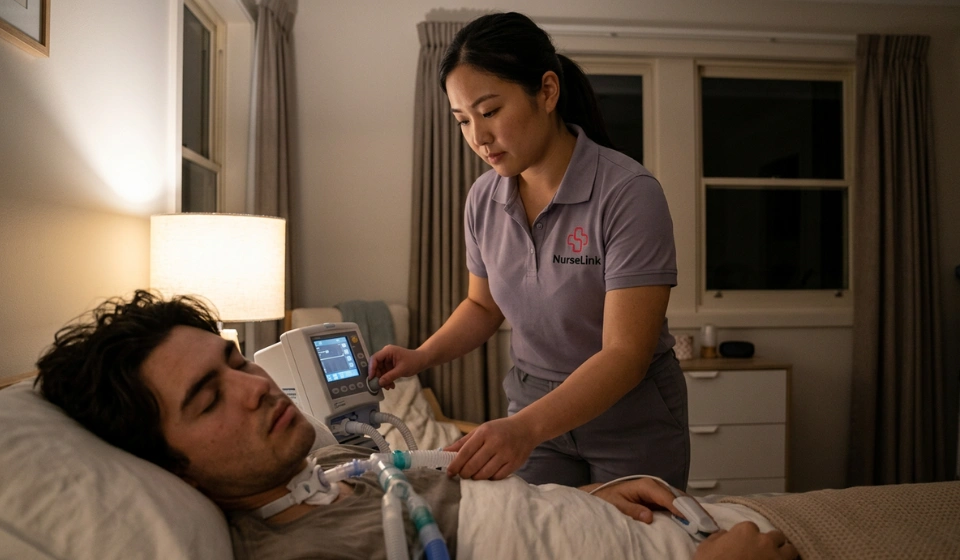
See How NurseLink's Overnight Ventilator Nursing Helped After Their Son's Serious Accident
A Case Study In Skilled Overnight Nursing That Protected A Family's Capacity To Keep Going
Introduction
There is a specific and cumulative exhaustion that comes from being the person responsible, night after night, for someone else’s breathing. Parents managing a ventilator-dependent adult child at home do not get the ordinary mercy of an uninterrupted night’s sleep, because a ventilator alarm, a tracheostomy that needs suctioning, a subtle change in colour or breathing pattern that only a trained eye would catch quickly enough, does not wait for a convenient hour. It happens whenever it happens, and someone has to be awake and competent enough to respond.
For families managing this kind of care in the early months after a serious accident, the days are often, paradoxically, more manageable than the nights. During the day there is structure, other people, therapy appointments, distraction. At night there is only the family, the equipment, and the accumulating fatigue of parents who are trying to hold together their own health, their marriage, their other children and their jobs, on top of managing complex overnight medical care that would exhaust even a trained nurse working a single shift, let alone parents doing it indefinitely on no sleep at all.
Overnight nursing support exists to break this specific and unsustainable pattern. It does not remove a family’s love or their involvement in their child’s care. It gives them back the one thing that chronic sleep deprivation makes it impossible to sustain: their own capacity to keep functioning, for as long as their son or daughter’s recovery requires them to.
This case study documents how NurseLink Healthcare provided overnight ventilator nursing for a young man in his early twenties in Perth, following a serious accident that left him tracheostomy and ventilator dependent, and how consistent, skilled overnight nursing gave his parents their sleep, and by extension their capacity to keep going, back.
To protect the privacy of the client and his family, all names and identifying details have been kept confidential throughout this case study.
The Client And His Family
The client is a man who was twenty-two at the time of his accident, living in Perth’s southern suburbs with his parents, having recently returned home after a period living independently while studying, a common enough arrangement for a young adult navigating the early stages of adulthood. He was involved in a serious motor vehicle accident that resulted in significant chest and airway trauma, requiring an extended period in intensive care followed by a lengthy inpatient rehabilitation admission before he was assessed as medically stable enough for discharge home.
He was discharged with a tracheostomy and ongoing ventilator support required overnight, alongside daytime respiratory needs that were, by the time of discharge, more manageable but still required careful monitoring. His parents, both of whom had taken extended leave from work during the acute phase of his recovery, had undergone training through the hospital’s discharge planning process to manage his tracheostomy and ventilator care themselves, understanding that his ongoing recovery would require this care indefinitely, or at least for a period measured in months rather than weeks.
The first several weeks at home had gone, by his parents’ own account, about as well as could be expected clinically, but had come at a cost that had become impossible to ignore. Neither parent had slept a full night since his discharge. They had split overnight monitoring between them in rotating shifts, each managing several hours of vigilance before waking the other, a system that meant neither of them was ever getting genuinely restorative sleep, and both were showing signs, by the time they contacted NurseLink Healthcare, of the kind of exhaustion that begins to compromise judgement and health in its own right.
His mother described, in the initial conversation, a particular moment that had prompted her to finally seek outside support. She had, during a night shift several weeks into his care, dozed off briefly beside his bed and woken in a state of panic, uncertain for several disorienting seconds whether anything had happened during the time she had been asleep. Nothing had. But the fear of what might have, combined with the accumulated exhaustion of the preceding weeks, made clear to both parents that the current arrangement, however devoted, was not sustainable and was beginning to introduce its own risks alongside the ones it was meant to prevent.
Understanding What The Family Actually Needed
The initial assessment NurseLink Healthcare conducted with the family involved both parents and, for part of the conversation, the client himself, who was clear, despite his significant injuries, that he wanted to remain involved in decisions about his own care and did not want to be spoken about as though he were not present in the room.
The family needed a qualified registered nurse, experienced specifically in tracheostomy and ventilator management, present overnight every night, competent to manage routine suctioning and equipment checks, respond immediately and correctly to any ventilator alarms or respiratory changes, and make sound clinical judgements about when a change in his condition warranted escalation. This needed to be reliable enough, night after night, that his parents could genuinely sleep through the night rather than remaining in a state of anxious semi-alertness even with a nurse present, which meant the nursing arrangement needed to establish real trust quickly.
His parents also needed, though it took a slightly longer conversation to articulate clearly, a nurse who would respect that this was still their son and their home, and who would keep them appropriately informed each morning without needing to wake them for anything short of a genuine concern, so that the overnight coverage functioned as real relief rather than a source of new anxiety about being kept in the dark.
The client, for his part, was direct that he wanted overnight nurses who would let him sleep when he was genuinely tired rather than waking him unnecessarily for routine checks that could be managed without disturbing him, and who would treat him, in whatever conversation did happen during the overnight hours, as a twenty-two year old man rather than only as a ventilator-dependent patient.
The NurseLink Healthcare Solution
A Small, Consistent Team Of Ventilator-Trained Nurses
NurseLink Healthcare assembled a small, consistent team of two registered nurses with specific tracheostomy and ventilator care experience, who alternated overnight coverage across the week, chosen deliberately for both their clinical expertise and a calm, competent manner that could build genuine trust with an exhausted family quickly. Before the first overnight shift, both nurses were thoroughly briefed on his specific equipment, his baseline respiratory pattern, his general medical history and the family’s explicit wish to be woken only when genuinely necessary.
Establishing Trust In The First Few Nights
The first several overnight shifts were approached deliberately as a trust-building period as much as a clinical one. The nursing team made a point of introducing themselves clearly to both parents at the start of each shift, confirming any relevant updates from the day and providing a clear, simple picture of what the night would involve, small steps that the care coordinator later identified as central to how quickly the parents were able to relax into genuine sleep rather than remaining anxiously alert despite the nurse’s presence.
Precise, Attentive Overnight Clinical Care
Across the engagement, the nursing team managed his overnight tracheostomy care, routine suctioning, equipment monitoring and prompt, correct response to any ventilator alerts with the consistent clinical precision his condition required, while working quietly and unobtrusively enough that his parents were rarely disturbed by the overnight routine itself. Any genuine clinical concerns, on the occasions they arose, were assessed promptly and escalated appropriately, with a clear and calm explanation provided to the parents the following morning rather than a panicked overnight wake-up unless the situation genuinely warranted it.
Respecting Him As A Young Man, Not Just A Patient
The nursing team, understanding the client’s own stated preference, made a point of treating the overnight hours as his time to rest rather than an opportunity for unnecessary interaction, while remaining genuinely engaged and personable during the periods he was awake and inclined to talk. One of the two nurses discovered, over the first few weeks, that he had a strong interest in a particular strategy video game he had played extensively before his accident and had begun, during the periods he was awake and wanted company, engaging him in conversation about it, a small point of connection his mother later identified as one of the things that made him seem, even during a genuinely difficult period, still recognisably himself.
Clear Morning Handovers That Let His Parents Rest Genuinely
Each morning, the outgoing nurse provided his parents with a clear, concise handover covering anything clinically relevant from the night, delivered calmly and without alarm even when minor issues had arisen, so his parents woke to a straightforward update rather than anxious uncertainty about what they had missed. This consistent, trustworthy handover routine became, over the following weeks, one of the specific elements that let his parents transition from anxious, fragmented sleep to genuinely restorative rest, because they came to trust, based on repeated experience, that they would be told clearly and promptly if anything had actually required their attention.
Outcomes & Impact
His Parents Slept Through The Night For The First Time In Weeks
Within the first fortnight of the arrangement, both parents reported sleeping through full nights for the first time since his discharge, a shift that their own GP, whom both had seen for review appointments related to their own health and exhaustion, identified as a significant and necessary change given the physical toll the preceding weeks of sleep deprivation had begun to take on both of them.
His Clinical Care Remained Stable And Well Managed
Across the engagement, his overnight respiratory status remained consistently well managed, with the nursing team’s clinical vigilance and prompt, correct responses to any changes contributing to a stable recovery trajectory that his respiratory consultant, reviewing his progress some months into the arrangement, identified as tracking positively and without the kind of overnight incident that inconsistent or fatigued care might otherwise have risked.
His Parents' Own Health And Capacity Recovered
Beyond the immediate relief of proper sleep, both parents reported, at a review conversation some weeks into the engagement, a broader recovery in their own physical and emotional capacity, describing themselves as feeling, for the first time since the accident, able to think clearly, manage their other responsibilities and be genuinely present for their son during the daytime hours rather than operating in a fog of accumulated exhaustion.
He Retained A Sense Of Himself Through A Difficult Recovery
The client himself, reflecting at a later stage of the engagement, described the overnight nursing team as having become people he genuinely looked forward to seeing on the nights he felt like talking, rather than simply clinical staff managing his equipment, a shift his mother identified as meaningful evidence that he remained engaged with his own recovery and his own sense of identity despite the significant disruption his accident had caused.
A Family Able To Sustain The Road Ahead
Perhaps the broadest outcome of the engagement was the family’s renewed capacity to sustain what remained a long recovery process. His father, at a review call several months into the arrangement, described the overnight nursing support as having quite literally made the difference between a recovery process the family could sustain and one that was, before NurseLink Healthcare’s involvement, beginning to genuinely threaten both parents’ own wellbeing.
A Reflection From His Mother
Several months into the engagement, she shared the following with the NurseLink Healthcare care coordinator:
“I did not understand how exhausted I was until I finally slept properly again. We were managing his care, technically, but we were falling apart doing it. The nurses NurseLink sent us are completely capable clinically, genuinely excellent at what they do, and they also talk to him about his video games and let him sleep when he needs to and wake gently when he does not. I sleep through the night now. My husband does too. We wake up able to actually be his parents during the day instead of two exhausted people barely holding on. I do not think people understand how much simply sleeping again can change until they have gone without it the way we had.”
Key Takeaways From This Case Study
Overnight nursing support protects the whole family’s capacity to sustain a long recovery, not just the client’s immediate clinical needs. Parents managing complex overnight care without relief face a genuine risk of their own health and judgement deteriorating, which ultimately compromises the quality of care the whole family can provide.
Trust needs to be built deliberately in the early nights of an overnight nursing arrangement. Families who have been managing anxious, fragmented sleep even with a nurse present need clear communication and demonstrated reliability before they can genuinely relax into proper rest.
A calm, trustworthy morning handover routine is what allows genuinely restorative sleep to happen. Parents’ ability to sleep through the night depends heavily on their confidence that they will be woken promptly if genuinely necessary and told clearly what happened if not, a trust built through consistent experience over time.
Respecting a young adult client’s preferences about rest and engagement matters clinically as well as personally. Nursing care that let this client sleep when tired and engage when he wanted to, on his own terms, supported both his physical recovery and his psychological sense of continued identity through a difficult period.
Consistency of nursing staff builds the familiarity that makes complex overnight care both safer and more humane. A small, known team who understood this client’s baseline and personality delivered stronger clinical outcomes and a materially better experience for both the client and his family than a rotating roster would have provided.
Conclusion
A serious accident that leaves a young adult ventilator dependent changes his family’s life as profoundly as it changes his own, and the exhaustion of managing complex overnight care alone can, left unaddressed, threaten the very capacity a family needs to sustain a long recovery. For the family at the centre of this case study, NurseLink Healthcare provided overnight nursing care that managed a complex clinical picture with genuine skill, while giving two exhausted parents back the one thing they needed most urgently to keep going: a full night’s sleep.
His parents sleep through the night now. His recovery continues to track well. And somewhere in Perth’s southern suburbs, there is a young man arguing amiably with his overnight nurse about the best strategy for a video game neither of them will admit to taking quite as seriously as they clearly do.
If your family is managing complex overnight care following a serious accident or illness, we encourage you to reach out to the NurseLink Healthcare team. We are here to manage the night so your family can be there, fully, for the day.
Latest Post
The Wound He Was Too Frightened To Look At

Giving A Family Their Days Back
When The Only Nurse Leaves
When The Contract Ended Without Warning
The Father Who Kept Showing Up
When The Cycle Cannot Wait
Keeping The Clinic Running
When The Highway Brought Them In
Holding The Line

Open On Day One

When The Wards Couldn’t Wait

Keeping The Unit Open
Burnout Across An Entire Healthcare Team
When The Roster Falls Apart At Midnight

One Sick Call, One Struggling Ward

When The Ambulance Left, The Real Work Started.
Reliable Nursing Support At Home

Ensuring Continuity Of Care With Nursing Agency Support

Restoring Stability In Aged Care

Nursing Agency Staffing Solution (Aged Care Facility)