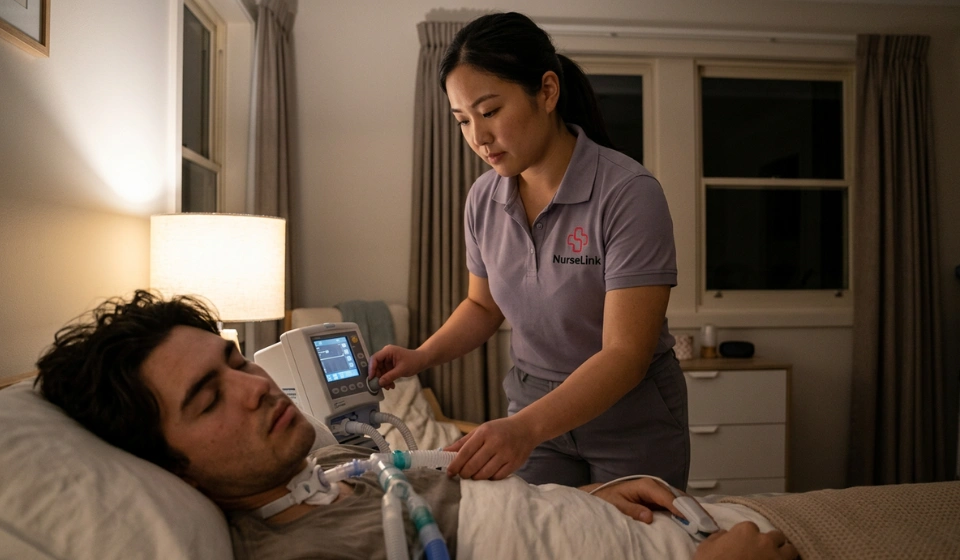
Giving A Family Their Days Back
How NurseLink Provided Complex Nursing Care For A Perth Teenager After A Life-Changing Injury
A Case Study In Skilled Nursing Support That Let A Family Return To Normality.
Introduction
There is a particular kind of exhaustion that settles over a family in the months after a child’s life changes suddenly and permanently. It is not only physical, though it is certainly that. It is the exhaustion of vigilance, of parents who have become, almost overnight, part-time clinicians in their own home, managing medication schedules and clinical observations and equipment they never expected to learn, while also trying to remain, underneath all of it, simply parents.
Complex nursing care in the home exists to relieve exactly this kind of exhaustion. For families managing a child or teenager with significant, ongoing medical needs following an acquired injury, qualified nursing support is not a luxury or a supplement. It is what allows the rest of the family’s life, work, school, siblings, a marriage, to continue functioning alongside the caregiving rather than being consumed entirely by it.
This case study documents how NurseLink Healthcare provided daytime nursing support for a teenage boy in Perth, Western Australia, following a serious spinal cord injury, and how that support gave his parents back the parts of their lives that the injury had, for a period, taken from them.
To protect the privacy of the client and his family, all names and identifying details have been kept confidential throughout this case study.
The Client & His Family
The client is a boy who was sixteen at the time of his injury, the middle of three children in a family living in Perth’s northern suburbs. He had been, by every account his parents gave, an ordinary and energetic teenager, more interested in football and his friends than in anything resembling caution, which was part of what made the accident that changed his life feel so cruelly disproportionate to how it happened.
He sustained a spinal cord injury in a diving accident at a local river during the summer holidays, an incident that took, by his mother’s account, no more than a few seconds and altered the shape of his family’s life for the foreseeable future. He spent several weeks in an acute spinal unit followed by a period of inpatient rehabilitation, and was discharged home with a level of injury that left him with significantly reduced mobility, a neurogenic bladder and bowel requiring a structured management regime, and a need for ongoing clinical monitoring that neither of his parents, however devoted, had the clinical training to manage safely on their own indefinitely.
His parents, both of whom worked, had taken extended leave in the immediate aftermath, as most parents in their position would. But leave is finite, mortgages and other responsibilities do not pause, and by the time his rehabilitation team began planning his discharge home, it had become clear to everyone involved, his parents included, that his ongoing care at home would need to include qualified nursing support if the family was going to have any chance of returning to something resembling their previous rhythm of life.
His younger sister, twelve at the time, and his older sister, nineting, had both, in their own ways, absorbed the disruption of the previous months. His discharge planner was direct with the family that the nursing support being arranged was not only for him. It was for all of them.
Understanding What The Family Actually Needed
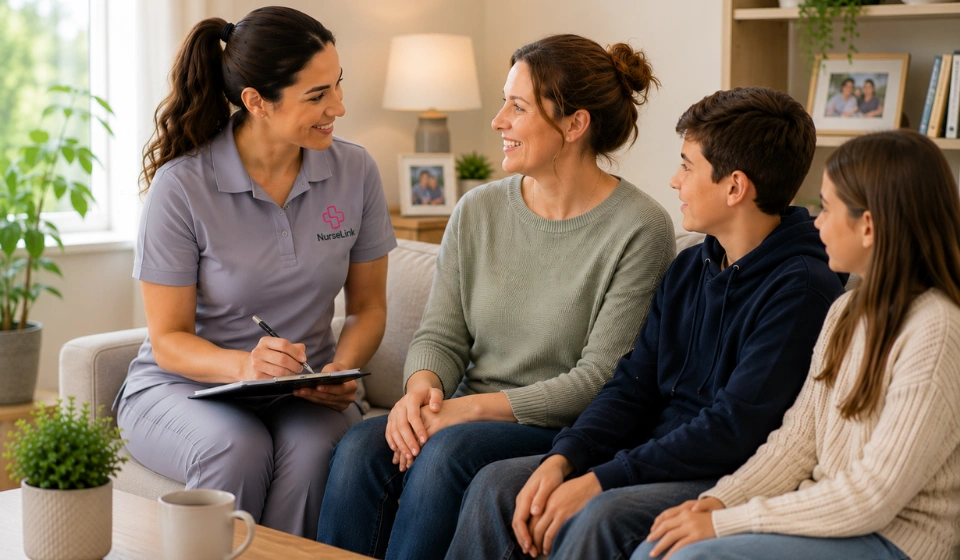
The initial assessment NurseLink Healthcare conducted with the family involved both parents, the discharge planning team from the rehabilitation hospital and, for part of the conversation, the client himself, who was clear that he wanted to be involved in decisions about his own care rather than have them made entirely around him, a preference the care coordinator noted as important and one that shaped how the engagement was structured from the outset.
The family needed a registered nurse present during weekday daytime hours to manage his bladder and bowel care regime, monitor for the pressure injury risk that his reduced mobility created, manage his medication schedule and be available to respond to the kind of clinical changes that a spinal cord injury of his level can present without warning. This coverage needed to be reliable enough that both parents could return to their jobs without the low-grade anxiety of wondering whether the arrangement would hold.
They also needed, though it took a slightly longer conversation to draw out, a nurse who would treat their son as a sixteen year old rather than as a set of clinical tasks. His mother was explicit about this. She said she had spent the past several months watching her son be talked about, in ward rounds and case conferences, in terms of his injury level and his care needs, and she did not want that pattern to continue in his own home, where he was, first and always, still just their son.
His father added that predictability mattered enormously to the family at this stage. The injury itself had been sudden and unpredictable in the worst possible way, and what the family needed now, more than almost anything else, was a nursing arrangement that behaved exactly as expected, day after day, so that some part of their life could feel settled again.
The NurseLink Healthcare Solution
Assembling A Small, Consistent Nursing Team
Rather than rostering a wide pool of nurses across the week, NurseLink Healthcare deliberately built a small, consistent team of two registered nurses who alternated the weekday coverage between them, both experienced in spinal cord injury care and both selected, in part, for a manner suited to working closely with a teenage client who valued being spoken to directly and treated with the ordinary respect any sixteen year old expects.
Both nurses were thoroughly briefed on his bladder and bowel management regime, his skin integrity monitoring requirements and his medication schedule, and both were briefed equally thoroughly on the family’s wish that his care be delivered in a way that kept him, rather than his injury, at the centre of the interaction.
Clinical Care Delivered With Genuine Rapport
The nursing team managed his catheter care, bowel regime and pressure area monitoring with the precision his injury required, while structuring the day around him rather than around the tasks alone. Sessions with his physiotherapist and occupational therapist, arranged around his nursing hours, were supported by the nursing team where clinically relevant, and the nurses made a point of involving him actively in decisions about his own care wherever it was appropriate to do so, which both nurses reported he responded to with visible relief.
One of the two nurses discovered, in the first fortnight, that he had followed a particular football club closely before his injury and had, if anything, become more invested in it since, given how much time he was now spending at home. She began, without it being part of any formal care plan, keeping up with the club’s results so she had something to discuss with him during the parts of the day that were not taken up with clinical tasks, a small adjustment that his mother later identified as one of the things that made the arrangement feel less like nursing care and more like having someone genuinely on his side in the house.
Supporting The Whole Household, Not Just The Client
The nursing team’s presence during weekday daytime hours meant his parents were able to return to their jobs with confidence that his clinical needs were being managed by someone qualified and known to the family, rather than being left to fit around their work schedules in a way that would have made a genuine return to work impossible. The nursing team also maintained a simple daily handover note for his parents, covering anything clinically relevant from the day, which meant his parents arrived home informed rather than needing to reconstruct the day’s events from scratch each evening.
His younger sister, who had struggled in the months immediately following the accident with a household that felt entirely reorganised around her brother’s needs, gradually noticed the household settle into a new and more sustainable rhythm as the nursing arrangement became established, which both parents identified, at a review call some months into the engagement, as one of the quieter but most important outcomes of the whole arrangement.
Outcomes & Impact
His Clinical Care Remained Stable & Well Managed
Across the engagement, his bladder and bowel regime remained consistently well managed, his skin integrity was closely monitored with no pressure injuries developing during the nursing period, and any changes in his condition were identified early by nurses who knew his baseline well enough to notice deviations from it quickly. His rehabilitation consultant, reviewing his progress some months after discharge, noted that the consistency of his home nursing care had been a meaningful contributor to the stability of his overall clinical picture.
His Parents Returned To Work
Both parents returned to their jobs within the timeframe they had hoped for, something that had felt genuinely uncertain in the weeks immediately following his discharge. His mother described the return to work as significant not only financially but psychologically, giving her back a part of her identity and her day that had been entirely absorbed by caregiving in the months since the accident.
He Was Treated Like Himself Again
Perhaps the outcome that mattered most to the family was the least clinical one. Their son, who had spent months being defined by his injury in almost every interaction with the medical system, had, within his own home, two nurses who knew his football team, asked about his friends and treated the clinical tasks as a normal part of the day rather than the entire content of it. His mother said, at a later review call, that watching him laugh with one of the nurses about a football result was one of the first moments since the accident that had felt genuinely ordinary.
The Household Found A New Rhythm
His sisters, and the family as a whole, gradually settled into a routine that accommodated his needs without being entirely organised around them, a shift both parents attributed directly to the reliability and quality of the nursing support in place.
A Reflection From His Mother
Near the end of the initial engagement period, she shared the following with the NurseLink Healthcare care coordinator:
“After the accident, everything about our lives became about managing his injury. That is not a complaint, it is just what happens. What NurseLink gave us was two nurses who were completely capable of managing everything clinical, and who also just liked him. They knew his football team. They gave him space to be a teenager again inside all of it. And they gave my husband and me our jobs and a little bit of our old life back. I did not think that was possible six months ago.”
Key Takeaways From This Case Study
Complex nursing care at home is family support, not just patient care. A nursing arrangement that manages a young person’s clinical needs well also, by extension, restores the rest of the family’s capacity to work, parent other children and function as a household.
Consistency of staff matters enormously for young clients. A small, known nursing team who understand a young person’s baseline and personality delivers both better clinical outcomes and a materially better experience than a rotating roster of unfamiliar staff.
Clinical skill and personal rapport are not competing priorities. The most effective nursing care in this engagement combined precise clinical management with a genuine interest in the young person as an individual, and the two reinforced rather than diminished each other.
Predictability is its own form of care after a sudden, unpredictable injury. Families recovering from a traumatic acquired injury often need reliability more than almost anything else. A nursing arrangement that behaves exactly as expected, day after day, provides a form of stability that has value well beyond the clinical tasks it delivers.
Conclusion
A serious acquired injury changes a family’s life in ways that ripple far beyond the person directly affected. For the family at the centre of this case study, NurseLink Healthcare provided nursing care that managed a complex clinical picture with genuine skill, while treating a sixteen year old boy as exactly that, a teenager, with a football team and a sense of humour and a life that deserved to keep being lived alongside his injury rather than in place of it.
His parents are back at work. His sisters have their family back. And somewhere in Perth’s northern suburbs, there is a teenage boy who still argues with his nurse about last weekend’s football result.
If your family is navigating complex nursing needs at home following an acquired injury or illness, we encourage you to reach out to the NurseLink Healthcare team. We are here to manage the clinical care so your family can get back to being a family.
Latest Post
The Wound He Was Too Frightened To Look At
Giving A Family Their Days Back
When The Only Nurse Leaves
When The Contract Ended Without Warning
The Father Who Kept Showing Up
When The Cycle Cannot Wait
Keeping The Clinic Running
When The Highway Brought Them In
Holding The Line
Open On Day One

When The Wards Couldn’t Wait
Keeping The Unit Open
Burnout Across An Entire Healthcare Team
When The Roster Falls Apart At Midnight

One Sick Call, One Struggling Ward

When The Ambulance Left, The Real Work Started.
Reliable Nursing Support At Home

Ensuring Continuity Of Care With Nursing Agency Support
Restoring Stability In Aged Care
Nursing Agency Staffing Solution (Aged Care Facility)