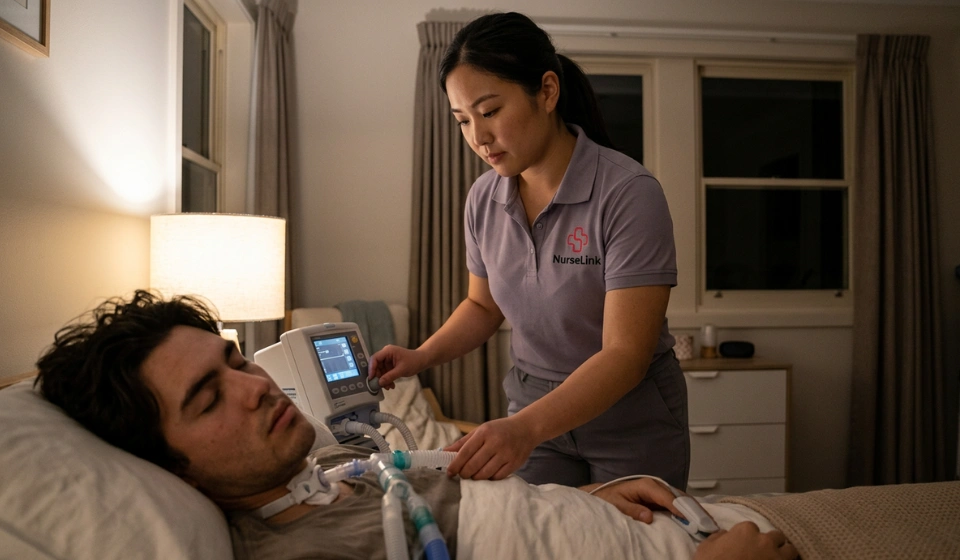
The Skill The Hospital Didn’t Have On Staff
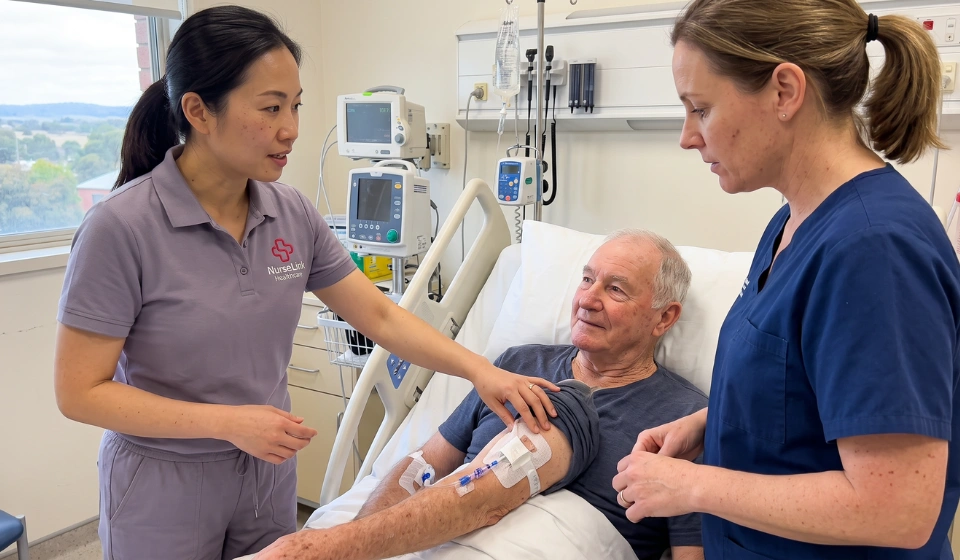
How NurseLink Healthcare's Specialist Nurse Placement Kept A Regional Patient Out Of A Two-Hour Ambulance Transfer
A Case Study In Filling A Rare Clinical Gap Before It Became Someone Else's Emergency
Introduction
Regional healthcare in Victoria operates, for the most part, remarkably well, small hospitals and residential facilities managing the full breadth of everyday clinical need with skill and resourcefulness that often goes unnoticed simply because it works. But every so often, a patient’s needs intersect with a genuinely rare and specialised skill set, one that a smaller facility, quite reasonably, has never had cause to keep on staff. When that happens, the usual answer has traditionally been transfer: load the patient into an ambulance, send them two or three hours down the highway to a metropolitan hospital that has the relevant specialist, and hope the journey itself doesn’t compound whatever risk the gap in local expertise was already creating.
This is not a failure of regional healthcare. It is simply the reality of distributing rare clinical specialisations across a state as large as Victoria. But it is also, increasingly, a gap that specialist nursing agency placement can close directly, bringing the specific expertise to the patient rather than the patient to the expertise, provided the right nurse can be identified and deployed quickly enough to matter.
This case study documents how NurseLink Healthcare placed a vascular access specialist nurse at a small regional hospital in Victoria’s north-east, closing a skills gap that would otherwise have required a complex and clinically risky transfer, and kept a patient’s treatment on track without ever leaving his own community.
To protect the privacy of all parties, identifying details of the client, the treating facility and its staff have been withheld or altered throughout this case study.
The Facility & Its Situation
The facility is a small regional hospital in Victoria’s north-east, serving a catchment of several rural townships, well equipped for general medical, surgical and emergency care but, like most facilities of its size, without a nurse credentialed in advanced vascular access, the insertion and ongoing management of peripherally inserted central catheters, commonly known as PICC lines, used for patients requiring extended courses of intravenous treatment.
A patient in his late fifties, a local farmer, had been admitted with a severe bone infection requiring six weeks of intravenous antibiotics, treatment that could not be safely managed through standard short-term IV access and required a PICC line for the full duration. The hospital’s usual solution in such cases was transfer to a metropolitan facility for both the initial line insertion and, more significantly, the specialised nursing management the line required for the following six weeks, dressing changes, patency checks and complication monitoring that demanded specific competency few of its permanent nursing staff held.
For this particular patient, that transfer carried real complications beyond the inconvenience. He ran a working farm with no one else able to manage it, was the primary carer for his elderly mother living with him, and had told his treating doctor plainly that a six-week admission at a hospital two hours from home was not something he could manage without abandoning responsibilities that, in a small rural community, had no easy substitute. His treating physician, aware of the situation, began exploring whether the necessary expertise could instead be brought to the hospital rather than the patient sent away from it.
Understanding What The Facility Actually Needed
When the hospital’s Director of Nursing contacted NurseLink Healthcare, the request was specific and, by the standards of general agency staffing, unusual: not a general registered nurse to cover a rostering gap, but a nurse specifically credentialed in vascular access, capable of both PICC line insertion and the ongoing specialised management the six-week treatment course would require, available at short notice and willing to work within a small regional facility’s existing team rather than simply parachuting in as an outside contractor.
The clinical requirement was clear, but the Director of Nursing was equally direct about a second, less clinical need: whoever filled this role would need to work genuinely well alongside her existing nursing staff, sharing knowledge and building their confidence around basic PICC line monitoring between specialist visits, rather than creating a scenario where the hospital’s own team became entirely dependent on an outside nurse for a patient in their own care. She was explicit that a placement which left her staff no more capable at the end of it than at the start would only partially solve her problem.
She also needed confidence, given how rarely her hospital engaged specialist agency placements of this kind, that NurseLink Healthcare could genuinely verify the credentials and experience of whoever was placed, given the clinical stakes of vascular access complications in a patient whose entire treatment plan depended on the line remaining viable for six full weeks.
The NurseLink Healthcare Solution
Matching A Genuinely Rare Credential, Not Just A Willing Nurse
NurseLink Healthcare’s specialist placement team identified a registered nurse with specific postgraduate credentialing in vascular access and several years of experience in both PICC line insertion and complex line management across acute and community settings, verified directly against the hospital’s stated requirements before any placement offer was made.
A Placement Structured Around Insertion & Ongoing Presence
Rather than a single visit for line insertion followed by irregular remote support, the placement was structured as an initial on-site visit for insertion and immediate post-procedure management, followed by a scheduled cadence of in-person visits across the six-week treatment course for dressing changes, patency assessment and complication monitoring, with a direct phone line to the specialist nurse available to the hospital’s own nursing staff between visits.
Deliberate Knowledge-Sharing With The Hospital's Own Team
At the Director of Nursing’s request, the specialist nurse structured each visit to include brief, practical teaching for the hospital’s permanent nursing staff, basic visual assessment for early signs of complication, correct technique for the simpler elements of dressing care they could safely manage day to day, and clear escalation criteria for when a situation required her specific expertise rather than general nursing judgement. This was treated as a core part of the placement, not an informal extra, with time built into each visit specifically for it.
Close Coordination With The Treating Physician
The specialist nurse maintained direct, regular communication with the patient’s treating physician throughout the six weeks, ensuring that any changes in the line’s status or the broader treatment course were addressed promptly and that decisions about the line’s management remained properly integrated with his overall care, rather than operating as a service running parallel to his medical treatment.
A Patient Kept Informed Throughout An Unfamiliar Process
Recognising that PICC line management was likely unfamiliar and slightly daunting for a patient managing it for the first time, the specialist nurse made a point, across the early visits particularly, of explaining clearly what she was checking for and why at each stage, giving him practical understanding of what to watch for himself between visits and reducing the anxiety that unfamiliar medical equipment can often create.
Outcomes & Impact
The Patient Completed His Full Treatment Course Without Transfer
Across the full six weeks, the PICC line remained viable and complication-free, allowing the patient to complete his entire course of intravenous antibiotics at his local hospital, without the transfer to a metropolitan facility that had originally seemed unavoidable.
He Was Able To Continue Managing His Farm & Caring For His Mother
By avoiding a six-week admission away from home, the patient retained the ability to oversee his farm’s operations, with support from a neighbour for the physically demanding tasks he could no longer manage himself, and continued providing care for his elderly mother throughout his treatment, both outcomes his treating physician noted would have been genuinely difficult to arrange had transfer been required.
The Hospital's Own Nursing Staff Gained Lasting Capability
By the end of the placement, several members of the hospital’s permanent nursing team had developed practical, working confidence in basic PICC line monitoring and dressing care, a capability the Director of Nursing noted would directly benefit future patients with similar needs, reducing the hospital’s reliance on specialist placement for more routine elements of vascular access management going forward.
The Facility Avoided A Costly & Clinically Risky Transfer
Beyond the direct benefit to the patient, the hospital avoided the cost, logistical complexity and clinical risk associated with an extended metropolitan transfer purely for specialist nursing management, a resolution the Director of Nursing described as changing how she thought about the hospital’s options for similar cases in future.
A New, Trusted Option For Future Skills Gaps
Following this placement, the hospital established an informal but genuine relationship with NurseLink Healthcare for future specialist staffing needs, a shift the Director of Nursing described as having changed her default assumption, from immediately planning around transfer whenever a rare skills gap emerged, to first asking whether the right specialist could instead be brought to her hospital.
A Reflection From The Director Of Nursing
Following the completion of the patient’s treatment, the hospital’s Director of Nursing shared the following with NurseLink Healthcare:
She said her first instinct, when this patient’s needs became clear, had been to start the transfer paperwork, because that had always been the answer to a gap like this one and she had never really had reason to question it. What changed her mind was realising there might be another option, and what confirmed it was working with a specialist nurse who did not simply parachute in and out, but genuinely invested in leaving her own team more capable than she found them. She said her staff still talk about what they learned, that patients with genuinely rare needs no longer automatically mean a transfer conversation in her mind, and that she now has a real option for situations she previously assumed had only one answer. She added that for a patient who could not have managed six weeks away from his farm and his mother, this was not a convenience, it was the difference between a treatment plan he could actually complete and one he might well have refused.
Key Takeaways From This Case Study
Rare clinical needs do not always require moving the patient. Specialist nursing placement can bring highly specific expertise directly to a regional facility, avoiding transfers that carry their own clinical risk and personal cost for the patient.
A good specialist placement should leave a facility’s own team more capable, not just serve its immediate clinical need. Deliberately building teaching time into each visit gave this hospital’s permanent staff lasting skills, not just a temporary fix.
Verified, genuinely specific credentialing matters enormously in rare-skill placements. A hospital entrusting complex vascular access management to an outside nurse needs real confidence in that nurse’s qualifications, not just their availability.
Close integration with the treating team protects continuity of care. Regular communication between the specialist nurse and the patient’s physician ensured the placement functioned as part of his overall treatment, not a service operating in isolation.
Solving a rare skills gap can change a facility’s default response to future ones. This placement shifted the hospital’s institutional assumption, from transfer as the only answer to specialist placement as a genuine first option.
Conclusion
A patient whose treatment plan seemed to require choosing between adequate care and staying near the farm and family who depended on him found, instead, that both were possible, once the right specialist expertise was brought directly to his local hospital rather than the other way around. For the facility and the patient at the centre of this case study, NurseLink Healthcare provided not only a rare and precisely matched clinical skill set, but a placement designed to leave the hospital genuinely stronger for having used it.
He completed his treatment at home. His farm kept running. And a regional hospital now has a real answer for the next patient whose needs don’t quite fit what’s already on staff.
If your facility is facing a clinical skills gap that transfer feels like the only answer to, we encourage you to reach out to the NurseLink Healthcare team. We bring the right expertise to where your patients already are.
Latest Post
The Patients The Clinic Kept Losing To The Hospital
The Skill The Hospital Didn’t Have On Staff
Keeping The Lights On, Properly
The Morning Her Carer Didn’t Come
The Wound He Was Too Frightened To Look At

Giving A Family Their Days Back
When The Only Nurse Leaves
When The Contract Ended Without Warning
The Father Who Kept Showing Up
When The Cycle Cannot Wait
Keeping The Clinic Running
When The Highway Brought Them In
Holding The Line
Open On Day One
When The Wards Couldn’t Wait
Keeping The Unit Open
Burnout Across An Entire Healthcare Team
When The Roster Falls Apart At Midnight
One Sick Call, One Struggling Ward

When The Ambulance Left, The Real Work Started.
Reliable Nursing Support At Home

Ensuring Continuity Of Care With Nursing Agency Support

Restoring Stability In Aged Care
Nursing Agency Staffing Solution (Aged Care Facility)